Calories in Shawarma, Hummus and Falafel (and How to Track Them)
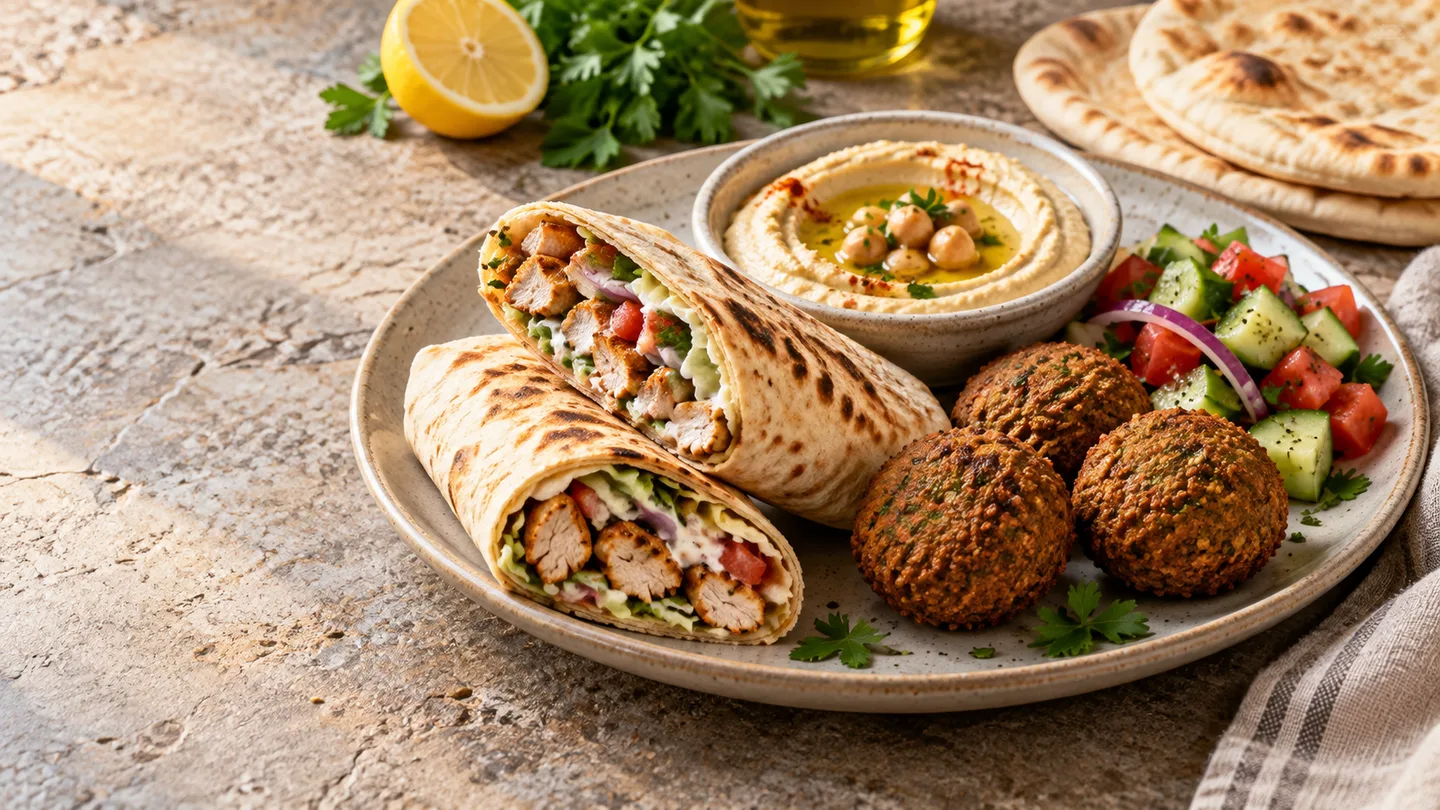
Shawarma, hummus and falafel are everyday foods across the Levant and the Gulf, and they are hard to log: the bread, the sauce, the cut of meat and the frying oil all move the number. This guide shows approximate ranges and exactly how each one was worked out.
All numbers on this page are approximate. Per-100 g figures are quoted from USDA FoodData Central. Per-portion figures are our own estimates from the stated weights, rounded to the nearest 10 kcal. In Australia? Multiply kcal by 4.184 for kilojoules (kJ).
How many calories are in shawarma?
USDA FoodData Central has no generic shawarma or doner kebab entry (we searched on 17 October 2026), so there is no single published number to quote. What we can do is build an estimate from components that USDA does list, and be explicit about every weight we assume. The meat entries below are plain roasted or broiled meat, not spit-roasted, marinated or basted shawarma meat, so treat them as stand-ins.
Per-100 g figures used
- Pita, white, enriched: 275 kcal per 100 g[1]
- Chicken thigh, meat only, roasted: 179 kcal per 100 g[2]
- Chicken thigh, meat and skin, roasted: 232 kcal per 100 g[3]
- Ground lamb, broiled, as a proxy for lamb shawarma: 283 kcal per 100 g[4]
- Garlic sauce: 683 kcal per 100 g[5]
- French fries, from fresh, fried: 198 kcal per 100 g[6]; from frozen, fried: 225 kcal per 100 g[7]
Assumed portion weights
These weights are our assumptions, not USDA data. Your wrap will differ. Salad and pickles are listed but not counted, because our reference set has no figure for them; they add a little.
| Component | Lighter case | Heavier case |
|---|---|---|
| Pita / flatbread | 60 g | 100 g |
| Meat in a wrap | 100 g | 150 g |
| Meat on a plate | 150 g | 200 g |
| Garlic sauce | 15 g (1 tablespoon) | 30 g (2 tablespoons) |
| Fries inside a wrap (optional) | 50 g | |
| Fries on a plate (optional) | none | 150 g |
| Salad, pickles | not counted | |
The arithmetic
Each component is grams × kcal per 100 g ÷ 100, shown exactly. The total is their sum, rounded to the nearest 10 kcal. All totals are approx.
| Meal | Lighter case (kcal) | Heavier case (kcal) | Range |
|---|---|---|---|
| Chicken shawarma wrap | Pita / flatbread: 60 g × 275 ÷ 100 = 165 Chicken thigh, meat only: 100 g × 179 ÷ 100 = 179 Garlic sauce: 15 g × 683 ÷ 100 = 102.45 165 + 179 + 102.45 = 446.45 |
Pita / flatbread: 100 g × 275 ÷ 100 = 275 Chicken thigh, with skin: 150 g × 232 ÷ 100 = 348 Garlic sauce: 30 g × 683 ÷ 100 = 204.9 275 + 348 + 204.9 = 827.9 |
approx. 450–830 kcal |
| Lamb shawarma wrap (ground lamb as proxy) | Pita / flatbread: 60 g × 275 ÷ 100 = 165 Ground lamb (proxy): 100 g × 283 ÷ 100 = 283 Garlic sauce: 15 g × 683 ÷ 100 = 102.45 165 + 283 + 102.45 = 550.45 |
Pita / flatbread: 100 g × 275 ÷ 100 = 275 Ground lamb (proxy): 150 g × 283 ÷ 100 = 424.5 Garlic sauce: 30 g × 683 ÷ 100 = 204.9 275 + 424.5 + 204.9 = 904.4 |
approx. 550–900 kcal |
| Chicken shawarma plate (pita on the side) | Chicken thigh, meat only: 150 g × 179 ÷ 100 = 268.5 Garlic sauce: 15 g × 683 ÷ 100 = 102.45 Pita / flatbread: 60 g × 275 ÷ 100 = 165 268.5 + 102.45 + 165 = 535.95 |
Chicken thigh, with skin: 200 g × 232 ÷ 100 = 464 Garlic sauce: 30 g × 683 ÷ 100 = 204.9 Pita / flatbread: 100 g × 275 ÷ 100 = 275 Fries (from frozen): 150 g × 225 ÷ 100 = 337.5 464 + 204.9 + 275 + 337.5 = 1281.4 |
approx. 540–1,280 kcal |
| Lamb shawarma plate (pita on the side) | Ground lamb (proxy): 150 g × 283 ÷ 100 = 424.5 Garlic sauce: 15 g × 683 ÷ 100 = 102.45 Pita / flatbread: 60 g × 275 ÷ 100 = 165 424.5 + 102.45 + 165 = 691.95 |
Ground lamb (proxy): 200 g × 283 ÷ 100 = 566 Garlic sauce: 30 g × 683 ÷ 100 = 204.9 Pita / flatbread: 100 g × 275 ÷ 100 = 275 Fries (from frozen): 150 g × 225 ÷ 100 = 337.5 566 + 204.9 + 275 + 337.5 = 1383.4 |
approx. 690–1,380 kcal |
The plate's lighter case has no fries and its heavier case has 150 g of them. Fries inside a wrap are optional: 50 g adds about 99 kcal (50 × 198 ÷ 100, from fresh) to 112.5 kcal (50 × 225 ÷ 100, from frozen), so roughly 100–110 kcal approx.
For comparison only: USDA lists a gyro sandwich at 184 kcal per 100 g[8]. A gyro is a different dish and we do not use it as a stand-in for shawarma.
In kilojoules
If you count in kJ (as in Australia), multiply kcal by 4.184. The chicken wrap range above, approx. 450–830 kcal, is approx. 1,880–3,470 kJ (450 × 4.184 = 1,880; 830 × 4.184 = 3,470, each rounded to the nearest 10).
Why the garlic sauce matters
Toum is mostly oil whipped with garlic. USDA's garlic sauce entry lists 683 kcal and 74.02 g of fat per 100 g[5], so fat is roughly three quarters of its weight. We assume 15 g per tablespoon; real spoons and restaurant ladles vary.
- 1 tablespoon: 15 × 683 ÷ 100 = 102.45 kcal, so approx. 100 kcal and about 11.1 g of fat.
- 2 tablespoons: 30 × 683 ÷ 100 = 204.9 kcal, so approx. 200 kcal.
- 3 tablespoons: 45 × 683 ÷ 100 = 307.35 kcal, so approx. 310 kcal.
That is why logging sauce by the spoonful, rather than leaving it out, changes an estimate more than most other choices.
How many calories are in hummus?
USDA's hummus entries do not agree, and the reason is visible in the data. Per 100 g:
- Hummus, home prepared: 177 kcal, 8.59 g fat[9]
- Hummus, commercial: 237 kcal, 17.8 g fat[10]
- Hummus, plain (FNDDS survey food): 243 kcal, 17.1 g fat[11]
The range is 177 to 243 kcal per 100 g. The commercial and survey entries carry about twice the fat of the home-prepared one (17.8 and 17.1 g versus 8.59 g per 100 g), which is consistent with more tahini and oil in the recipe. We cannot see the full recipes behind each entry, so use the range rather than picking one end.
Portions, assuming 15 g per tablespoon and rounding to the nearest 10 kcal (all approx.):
| Portion | Basis | Approx. kcal |
|---|---|---|
| 2 tablespoons (30 g) | 30 × 177 ÷ 100 = 53.1; 30 × 243 ÷ 100 = 72.9 | 50–70 |
| Restaurant plate (200 g assumed) | 200 × 177 ÷ 100 = 354; 200 × 243 ÷ 100 = 486 | 350–490 |
| Olive oil drizzle (1 tablespoon, 14 g assumed) | 14 × 884 ÷ 100 = 123.76[12]; 14 × 900 ÷ 100 = 126[13] | 120–130 |
A drizzle on top is easy to forget in a log, and the bread you scoop with is extra.
Tahini
Tahini is the other big contributor. USDA lists 592 kcal per 100 g[14] (type of kernels unspecified), 595 kcal[15] (roasted and toasted kernels) and 697 kcal[16] (FNDDS survey food), a range of 592–697. Their fat figures differ too (53–62.4 g per 100 g), so the entries describe somewhat different products. One tablespoon (15 g assumed) is 15 × 592 ÷ 100 = 88.8 to 15 × 697 ÷ 100 = 104.55, so approx. 90–100 kcal of plain tahini. Tahini sauce is usually thinned with water and lemon, so a spoonful of it will be lower; we have no USDA figure for it and do not give one.
How many calories are in falafel?
Falafel shows the biggest disagreement between datasets. Per 100 g:
- Falafel, home-prepared (SR Legacy): 333 kcal, 17.8 g fat[17]
- Falafel (FNDDS survey food): 514 kcal, 41.19 g fat[18]
That is 333 versus 514 kcal per 100 g. The fat figures (17.8 g versus 41.19 g) show where the gap comes from: the survey entry is consistent with deep-fried falafel that has absorbed a lot of frying oil, while the home-prepared entry has far less fat. How much oil falafel soaks up depends on size, batter density, oil temperature and frying time, which is why we show a range.
Per piece, with weights we assume (approx., nearest 10 kcal):
| Portion | Basis | Approx. kcal |
|---|---|---|
| 1 small piece (20 g assumed) | 20 × 333 ÷ 100 = 66.6; 20 × 514 ÷ 100 = 102.8 | 70–100 |
| 1 large piece (40 g assumed) | 40 × 333 ÷ 100 = 133.2; 40 × 514 ÷ 100 = 205.6 | 130–210 |
| Falafel sandwich (200–300 g assumed) | 200 × 265 ÷ 100 = 530; 300 × 265 ÷ 100 = 795[19] | 530–800 |
The sandwich figure uses USDA's composite falafel sandwich entry (265 kcal per 100 g), not the falafel pieces plus bread, so it is a separate estimate. Baked or air-fried falafel will usually sit lower than deep-fried, but we have no USDA figure for them. Size varies a lot between shops, so counting pieces and noting their size beats a single "1 serve" entry.
Why these meals are tricky to log
- Hidden fats. Oil in hummus, toum, frying oil and basting fat do not show in a photo.
- Shared plates. Mezze is eaten family-style, so your portion is a guess.
- Names vary. A shawarma in Beirut, one in Riyadh and a "kebab wrap" in Sydney can be quite different meals.
- Database gaps. As above, USDA has no shawarma entry at all, and the entries it does have for hummus and falafel disagree.
Practical ways to track them
- Log the parts, not the dish. Bread, meat, sauce and extras give a better estimate than one "shawarma" entry.
- Count the sauce. Ask for it on the side and log the spoonfuls you used.
- Count falafel pieces and note whether they are small or large.
- For mezze, estimate your share in spoonfuls rather than "a bit".
- Use a range. If you are unsure, log the middle of the range and keep going. Consistency beats perfection.
- Weigh it once at home. Weighing a typical portion of hummus once will calibrate your eye.
Where Calorie Coach Me fits
Calorie Coach Me gives you an approximate calorie and macro estimate from a meal photo. A photo cannot reliably see hidden oil, exact weights or recipes, so you review the result and correct the dish name, ingredients or portion before saving. The tips above still apply; the app just makes the first guess quicker.
Local Food Mode (Beta) lets you choose a food culture, such as Israel & the Levant or Gulf & Arabian Peninsula, so the estimate takes dishes like these into account. The app is available in 19 languages, on Android and on the web. If notebook and kitchen scale work better for you, everything above works with those too.
FAQ
Is hummus high in calories?
The USDA entries above give 177 to 243 kcal per 100 g, depending on the recipe. Portion size and added olive oil change the total the most.
Are falafel fried?
Traditionally, yes. Baked and air-fried versions exist.
How close are photo calorie estimates for these foods?
They are a starting point only. Photos cannot reliably see oil, sauces inside a wrap or exact weights, so review and adjust every result.
Is this medical or dietary advice?
No. These are general, approximate figures. For personal advice, talk to an Accredited Practising Dietitian or another qualified health professional.
Try it
Get the Android app Try it free on the web
Sources
- USDA FoodData Central: Bread, pita, white, enriched (SR Legacy, published 2019-04-01), FDC ID 174915. Values per 100 g as published.
- USDA FoodData Central: Chicken, broilers or fryers, thigh, meat only, cooked, roasted (SR Legacy, published 2019-04-01), FDC ID 172388. Values per 100 g as published.
- USDA FoodData Central: Chicken, broilers or fryers, thigh, meat and skin, cooked, roasted (SR Legacy, published 2019-04-01), FDC ID 173625. Values per 100 g as published.
- USDA FoodData Central: Lamb, ground, cooked, broiled (SR Legacy, published 2019-04-01), FDC ID 172544. Values per 100 g as published.
- USDA FoodData Central: Garlic sauce (Survey (FNDDS), published 2024-10-31), FDC ID 2710169. Values per 100 g as published.
- USDA FoodData Central: Potato, french fries, from fresh, fried (Survey (FNDDS), published 2024-10-31), FDC ID 2709458. Values per 100 g as published.
- USDA FoodData Central: Potato, french fries, from frozen, fried (Survey (FNDDS), published 2024-10-31), FDC ID 2709463. Values per 100 g as published.
- USDA FoodData Central: Gyro sandwich (Survey (FNDDS), published 2024-10-31), FDC ID 2706962. Values per 100 g as published.
- USDA FoodData Central: Hummus, home prepared (SR Legacy, published 2019-04-01), FDC ID 172454. Values per 100 g as published.
- USDA FoodData Central: Hummus, commercial (SR Legacy, published 2019-04-01), FDC ID 174289. Values per 100 g as published.
- USDA FoodData Central: Hummus, plain (Survey (FNDDS), published 2024-10-31), FDC ID 2707402. Values per 100 g as published.
- USDA FoodData Central: Oil, olive, salad or cooking (SR Legacy, published 2019-04-01), FDC ID 171413. Values per 100 g as published.
- USDA FoodData Central: Olive oil (Survey (FNDDS), published 2024-10-31), FDC ID 2710186. Values per 100 g as published.
- USDA FoodData Central: Seeds, sesame butter, tahini, type of kernels unspecified (SR Legacy, published 2019-04-01), FDC ID 168604. Values per 100 g as published.
- USDA FoodData Central: Seeds, sesame butter, tahini, from roasted and toasted kernels (most common type) (SR Legacy, published 2019-04-01), FDC ID 170189. Values per 100 g as published.
- USDA FoodData Central: Tahini (Survey (FNDDS), published 2024-10-31), FDC ID 2707587. Values per 100 g as published.
- USDA FoodData Central: Falafel, home-prepared (SR Legacy, published 2019-04-01), FDC ID 172455. Values per 100 g as published.
- USDA FoodData Central: Falafel (Survey (FNDDS), published 2024-10-31), FDC ID 2707408. Values per 100 g as published.
- USDA FoodData Central: Falafel sandwich (Survey (FNDDS), published 2024-10-31), FDC ID 2707483. Values per 100 g as published.
Per-100 g values are quoted from USDA FoodData Central (retrieved 17 October 2026). SR Legacy and FNDDS entries can differ for the same food because recipes and oil absorption differ. Portion weights, the 15 g tablespoon and the other assumptions are ours and are stated where they are used.
Last reviewed: 18 October 2026