Calories in a Prato Feito (Rice, Beans, Egg and Meat), Farofa and Pão de Queijo
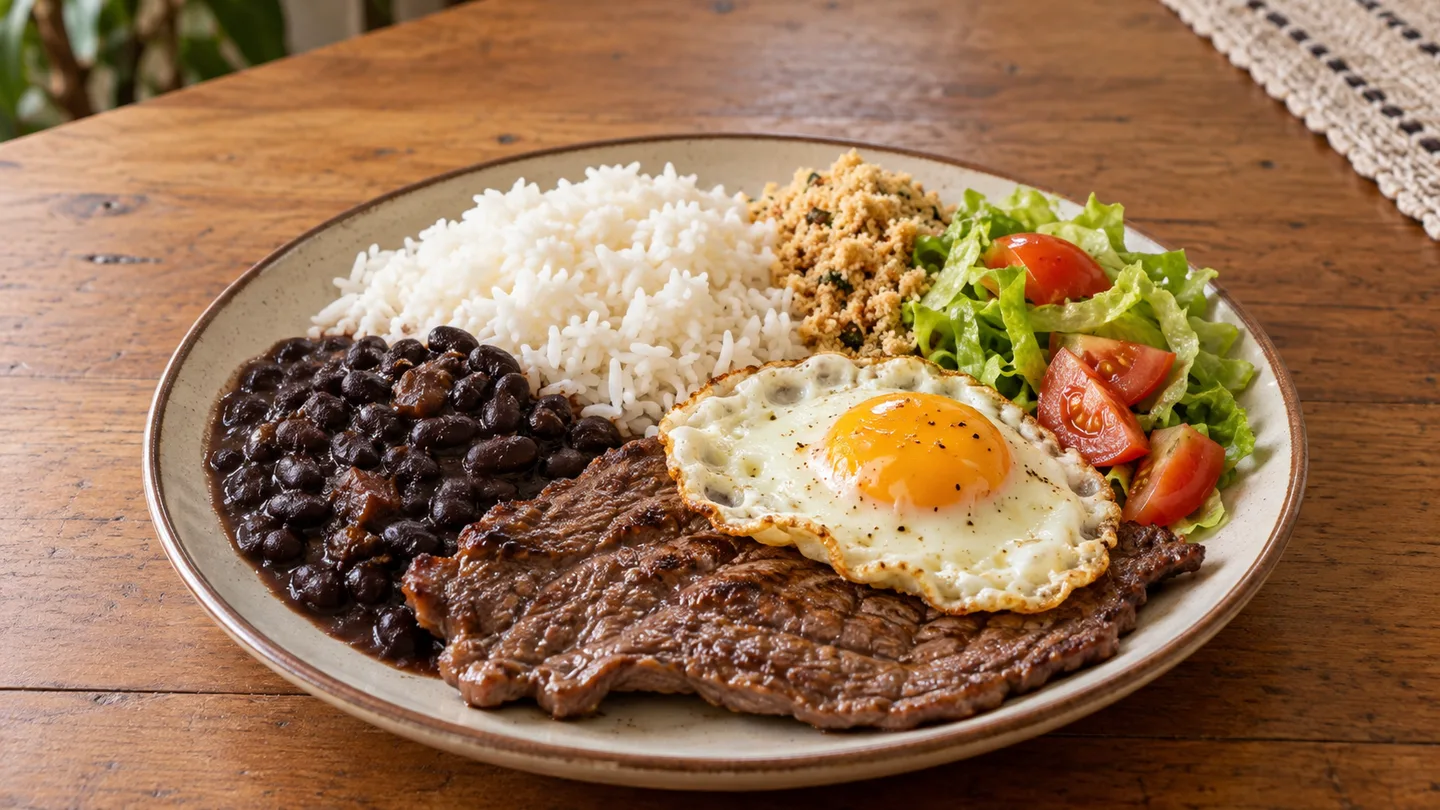
Rice and beans with a fried egg, a steak or a chicken fillet and a little salad: the prato feito is lunch for millions of Brazilians. It is also easy to under-log, because the oil in the rice, the size of the scoop of beans and the farofa on top all move the number. This guide shows approximate ranges and exactly how each one was worked out.
All numbers on this page are approximate. Per-100 g figures are quoted from USDA FoodData Central, a US database; Brazilian recipes can differ. Per-portion figures are our own estimates from the stated weights, rounded to the nearest 10 kcal. Brazilian labels show kcal and kJ: multiply kcal by 4.184 for kilojoules (kJ).
How many calories are in a prato feito?
USDA FoodData Central has no "prato feito" entry, so we build the plate from its parts. For each part we chose the closest USDA entry in our 18 October 2026 search results and say why below. None of these entries is a Brazilian recipe, so treat them as stand-ins.
Per-100 g figures used
- White rice, cooked, no added fat: 129 kcal per 100 g[1]; made with oil: 151 kcal per 100 g[2]
- Pinto beans, boiled, with salt, as the closest match for feijão carioca: 143 kcal per 100 g[3]. Black beans (feijão preto), boiled, with salt: 132 kcal per 100 g[4]
- Egg, fried with oil: 192 kcal per 100 g[5]
- Beef steak, round (a lean cut): 166 kcal per 100 g[6]; beef steak, cut not specified: 229 kcal per 100 g[7]
- Chicken breast, skinless, grilled: 151 kcal per 100 g[8] (SR Legacy); chicken breast, grilled without sauce, skin not eaten: 176 kcal per 100 g[9] (FNDDS survey food)
Why these entries: Brazilian rice is usually sautéed in oil with garlic and onion before the water goes in, so "made with oil" is the typical case and "no added fat" the lighter one (22 kcal per 100 g apart). Feijão carioca is a pinto-type bean, so we use pinto beans; black beans are 132 kcal per 100 g, close enough that the choice barely matters. Home-cooked beans are often seasoned with oil, garlic or bacon, which these plain boiled entries do not include, so the beans figure is a floor. For the egg, "fried with oil" matches the usual ovo frito; the SR Legacy fried egg (196 kcal[10]) is only 4 kcal per 100 g higher. For beef, we use a lean round steak for the lighter case and the "cut not specified" entry for the heavier one, because a bife acebolado or contrafilé can be lean or fatty. For chicken, the two grilled-breast entries disagree (151 versus 176), so we use one for each case.
Assumed portion weights
These weights are our assumptions, not USDA data. Restaurant plates vary a lot, and your own scoop is the best guide. The salad (lettuce, tomato, onion) is listed but not counted, because our reference set has no figure for it; without dressing it adds little.
| Component | Lighter case | Heavier case |
|---|---|---|
| Rice | 150 g | 200 g |
| Beans, with some broth | 100 g | 150 g |
| Fried egg (1 large) | 50 g | |
| Beef steak or chicken fillet | 100 g | 150 g |
| Salad, without dressing | not counted | |
The arithmetic
Each component is grams × kcal per 100 g ÷ 100, shown exactly. The total is their sum, rounded to the nearest 10 kcal. All totals are approx.
| Meal | Lighter case (kcal) | Heavier case (kcal) | Range |
|---|---|---|---|
| Prato feito with beef steak | Rice, no added fat: 150 g × 129 ÷ 100 = 193.5 Beans (pinto): 100 g × 143 ÷ 100 = 143 Fried egg: 50 g × 192 ÷ 100 = 96 Beef steak, round: 100 g × 166 ÷ 100 = 166 193.5 + 143 + 96 + 166 = 598.5 |
Rice, made with oil: 200 g × 151 ÷ 100 = 302 Beans (pinto): 150 g × 143 ÷ 100 = 214.5 Fried egg: 50 g × 192 ÷ 100 = 96 Beef steak, cut not specified: 150 g × 229 ÷ 100 = 343.5 302 + 214.5 + 96 + 343.5 = 956 |
approx. 600–960 kcal |
| Prato feito with grilled chicken | Rice, no added fat: 150 g × 129 ÷ 100 = 193.5 Beans (pinto): 100 g × 143 ÷ 100 = 143 Fried egg: 50 g × 192 ÷ 100 = 96 Chicken breast (SR Legacy): 100 g × 151 ÷ 100 = 151 193.5 + 143 + 96 + 151 = 583.5 |
Rice, made with oil: 200 g × 151 ÷ 100 = 302 Beans (pinto): 150 g × 143 ÷ 100 = 214.5 Fried egg: 50 g × 192 ÷ 100 = 96 Chicken breast (FNDDS): 150 g × 176 ÷ 100 = 264 302 + 214.5 + 96 + 264 = 876.5 |
approx. 580–880 kcal |
A tablespoon of oil on the salad (14 g assumed) adds 14 × 884 ÷ 100 = 123.76 kcal, so approx. 120 kcal[11]. That is more than the lettuce and tomato together, so log the dressing if you use it. Fries (batata frita) and farofa are common extras and are counted separately below.
In kilojoules
Brazilian food labels show both kcal and kJ. To convert, multiply kcal by 4.184. The plates above run from approx. 580 to 960 kcal, which is approx. 2,430–4,020 kJ (580 × 4.184 = 2,430; 960 × 4.184 = 4,020, each rounded to the nearest 10).
Farofa, feijoada and couve: dishes with no USDA entry
USDA FoodData Central has no farofa or feijoada entry; our searches for both on 18 October 2026 returned nothing. So the figures below are estimates built from other entries, and each proxy is explained.
Farofa
Farofa is toasted cassava flour, usually with butter or oil and sometimes onion, bacon or egg. The USDA cassava flour entry in our results has no energy value, so we cannot use it. Instead we use dry tapioca pearls (358 kcal per 100 g[12]) as a stand-in: both are dry cassava products, but tapioca is the extracted starch while farinha de mandioca is the whole root, so the real figure may be somewhat different. For the fat we use the olive oil entry (884 kcal per 100 g); butter has a little water in it and so slightly fewer kcal per gram. The lighter case is 2 tablespoons (30 g) of a dry farofa; the heavier case is 4 tablespoons (60 g) of a buttery one. Bacon, sausage or egg in the farofa add more.
| Meal | Lighter case (kcal) | Heavier case (kcal) | Range |
|---|---|---|---|
| Farofa (estimate from proxies) | Dry cassava (tapioca entry, proxy): 27 g × 358 ÷ 100 = 96.66 Oil or fat (olive oil entry, proxy): 3 g × 884 ÷ 100 = 26.52 96.66 + 26.52 = 123.18 |
Dry cassava (tapioca entry, proxy): 50 g × 358 ÷ 100 = 179 Oil or fat (olive oil entry, proxy): 10 g × 884 ÷ 100 = 88.4 179 + 88.4 = 267.4 |
approx. 120–270 kcal |
Feijoada
The closest USDA entry is "Black beans with meat" (177 kcal and 6.81 g of fat per 100 g[13]). It is not feijoada: a feijoada completa usually has fattier cuts (linguiça, bacon, pork ribs, carne-seca), so it is likely to be higher than this entry, sometimes by a lot. Use it as a lower bound. The usual side of couve refogada is closest to "Collards, fresh, cooked with oil" (61 kcal per 100 g[14]).
| Portion | Basis | Approx. kcal |
|---|---|---|
| Feijoada, 1 ladle to 1 deep plate (250–350 g assumed), proxy entry | 250 × 177 ÷ 100 = 442.5; 350 × 177 ÷ 100 = 619.5 | 440–620 |
| Couve refogada (80 g assumed) | 80 × 61 ÷ 100 = 48.8 | 50 |
A full feijoada lunch adds rice, farofa, couve and orange slices to the beans; log each part rather than one "feijoada" entry. Fries, torresmo and a caipirinha are extras on top.
Pão de queijo and açaí
Pão de queijo
USDA has no pão de queijo entry. The closest in our results is "Bread, cheese", listed at 408 kcal and 20.8 g of fat per 100 g in SR Legacy[15] and 408 kcal in FNDDS[16]; the two entries agree. It is a proxy only: the entry does not say what flour it uses, while pão de queijo is made with polvilho (cassava starch), cheese, egg, milk and oil. Treat the figures below as a rough guide and weigh one of your usual size once if you eat them often.
| Portion | Basis | Approx. kcal |
|---|---|---|
| 1 small pão de queijo (20 g assumed) | 20 × 408 ÷ 100 = 81.6 | 80 |
| 1 large pão de queijo (50 g assumed) | 50 × 408 ÷ 100 = 204 | 200 |
Açaí
The only açaí entries in our USDA results are drinks, such as "Fruit juice, acai blend" at 62 kcal per 100 g[17]. That is not the frozen açaí pulp served in a bowl, and a bowl usually also has guaraná syrup, granola, banana, condensed milk or powdered milk. We have no USDA figure for açaí pulp or an açaí bowl, so we do not give one. Log the bowl as its parts, and check the label of the pulp you buy.
Why the prato feito is tricky to log
- Hidden oil. Rice sautéed in oil, beans seasoned with oil or bacon, a fried egg and a buttery farofa do not show in a photo.
- Scoops, not weights. A self-service kilo restaurant weighs your plate, but most of us eat by the spoonful.
- Names vary. PF, prato do dia, comercial and executivo can mean quite different plates from one city to the next.
- Database gaps. As above, USDA has no entry for farofa, feijoada or pão de queijo, so any figure for them is an estimate.
Practical ways to track it
- Log the parts, not the dish. Rice, beans, egg, meat and extras give a better estimate than one "prato feito" entry.
- Count serving spoons. Weigh one spoonful of your rice and of your beans at home once, then count spoons.
- Log farofa and dressing. They are small in volume but add up.
- At a kilo restaurant, the plate weight on your receipt is a useful starting point.
- Use a range. If you are unsure, log the middle of the range and keep going. Consistency beats perfection.
Where Calorie Coach Me fits
Calorie Coach Me gives you an approximate calorie and macro estimate from a meal photo. A photo cannot reliably see the oil in the rice, the fat in the beans or exact weights, so you review the result and correct the dish name, ingredients or portion before saving. The tips above still apply; the app just makes the first guess quicker. See how it works.
Local Food Mode (Beta) lets you choose a food culture, such as Brazil or East Africa & the Horn, so the estimate takes dishes like these into account. It is a beta feature and its estimates are approximate too. The app is available in 19 languages, on Android and on the web.
Related: calories in ugali, chapati and pilau and calories in shawarma, hummus and falafel.
FAQ
How many calories are in rice and beans?
Per 100 g, the entries above give cooked white rice 129 to 151 kcal depending on the oil, and boiled beans 132 to 143 kcal before any seasoning fat. The table above shows the sums for typical plates.
Is there a USDA figure for feijoada or farofa?
No. We searched on 18 October 2026 and found none, so the figures on this page are estimates from stated proxies.
How close are photo calorie estimates for these foods?
They are a starting point only. Photos cannot reliably see oil, fat in the beans or exact weights, so review and adjust every result.
Is this medical or dietary advice?
No. These are general, approximate figures. For personal advice, talk to a registered dietitian (nutricionista) or another qualified health professional.
Try it
Get the Android app Try it free on the web
Sources
- USDA FoodData Central: Rice, white, cooked, no added fat (Survey (FNDDS), published 2024-10-31), FDC ID 2708408. Values per 100 g as published.
- USDA FoodData Central: Rice, white, cooked, made with oil (Survey (FNDDS), published 2024-10-31), FDC ID 2708404. Values per 100 g as published.
- USDA FoodData Central: Beans, pinto, mature seeds, cooked, boiled, with salt (SR Legacy, published 2019-04-01), FDC ID 173796. Values per 100 g as published.
- USDA FoodData Central: Beans, black, mature seeds, cooked, boiled, with salt (SR Legacy, published 2019-04-01), FDC ID 175237. Values per 100 g as published.
- USDA FoodData Central: Egg, whole, fried with oil (Survey (FNDDS), published 2024-10-31), FDC ID 2707158. Values per 100 g as published.
- USDA FoodData Central: Beef, steak, round (Survey (FNDDS), published 2024-10-31), FDC ID 2705831. Values per 100 g as published.
- USDA FoodData Central: Beef, steak, NFS (Survey (FNDDS), published 2024-10-31), FDC ID 2705824. Values per 100 g as published.
- USDA FoodData Central: Chicken, broiler or fryers, breast, skinless, boneless, meat only, cooked, grilled (SR Legacy, published 2019-04-01), FDC ID 171534. Values per 100 g as published.
- USDA FoodData Central: Chicken breast, grilled without sauce, skin not eaten (Survey (FNDDS), published 2024-10-31), FDC ID 2705968. Values per 100 g as published.
- USDA FoodData Central: Egg, whole, cooked, fried (SR Legacy, published 2019-04-01), FDC ID 173423. Values per 100 g as published.
- USDA FoodData Central: Oil, olive, salad or cooking (SR Legacy, published 2019-04-01), FDC ID 171413. Values per 100 g as published.
- USDA FoodData Central: Tapioca, pearl, dry (SR Legacy, published 2019-04-01), FDC ID 169717. Values per 100 g as published.
- USDA FoodData Central: Black beans with meat (Survey (FNDDS), published 2024-10-31), FDC ID 2707366. Values per 100 g as published.
- USDA FoodData Central: Collards, fresh, cooked with oil (Survey (FNDDS), published 2024-10-31), FDC ID 2709582. Values per 100 g as published.
- USDA FoodData Central: Bread, cheese (SR Legacy, published 2019-04-01), FDC ID 167944. Values per 100 g as published.
- USDA FoodData Central: Bread, cheese (Survey (FNDDS), published 2024-10-31), FDC ID 2707618. Values per 100 g as published.
- USDA FoodData Central: Fruit juice, acai blend (Survey (FNDDS), published 2024-10-31), FDC ID 2710777. Values per 100 g as published.
Per-100 g values are quoted from USDA FoodData Central (retrieved 18 October 2026). SR Legacy and FNDDS entries can differ for the same food because recipes and cooking fat differ. Portion weights, the proxies for farofa, feijoada and pão de queijo, and the other assumptions are ours and are stated where they are used.
Last reviewed: 18 October 2026