Calories in Ugali, Chapati, Pilau and Other East African Staples
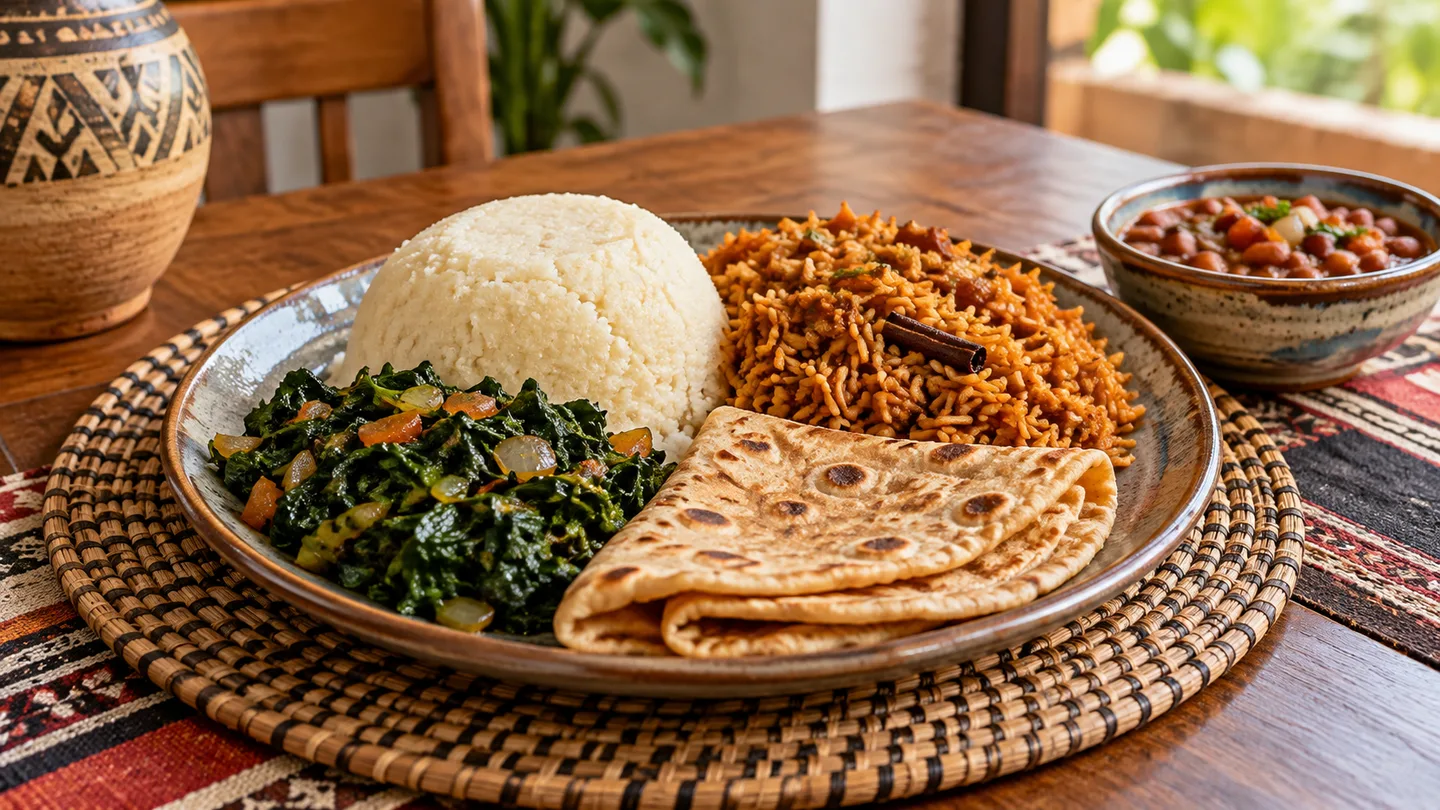
Ugali with sukuma wiki, chapati with beans, a plate of pilau, mandazi with chai: these are everyday meals in Kenya, Tanzania and Uganda. Most of them have no entry in the big nutrition databases, so any calorie figure has to be built from something close. This guide shows approximate ranges, the stand-ins we used and exactly how each number was worked out.
All numbers on this page are approximate. Per-100 g figures are quoted from USDA FoodData Central, a US database with no East African recipes, so several figures below rely on proxies that we name. Per-portion figures are our own estimates from the stated weights, rounded to the nearest 10 kcal. Many labels in the region show kJ: multiply kcal by 4.184 for kilojoules (kJ).
How many calories are in ugali?
USDA FoodData Central has no ugali entry (we searched on 18 October 2026). The closest cooked foods are American maize porridges, per 100 g:
- Cornmeal mush, no added fat: 58 kcal[1]
- White corn grits, cooked with water, without salt: 71 kcal[2]
- White cornmeal, dry (a Navajo white maize meal, the closest dry white maize flour in our results): 398 kcal[3]
Mush and grits are much softer than ugali: they hold more water, so their figure per 100 g is lower than ugali's. Water adds no calories, so a better way is to count the dry flour. Ugali is just maize flour (unga) and water, so the calories in a serving are roughly the calories in the flour that went into it. We assume a serving is made from 75 g of flour (lighter case) to 125 g (heavier case), and use the dry cornmeal entry as a stand-in for sifted unga. Weigh the flour you use once to check.
| Portion | Basis | Approx. kcal |
|---|---|---|
| Ugali made from 75–125 g of dry maize flour (recommended method) | 75 × 398 ÷ 100 = 298.5; 125 × 398 ÷ 100 = 497.5 | 300–500 |
| 300 g of ugali if it were as soft as mush or grits (lower bound only) | 300 × 58 ÷ 100 = 174; 300 × 71 ÷ 100 = 213 | 170–210 |
The two methods give very different numbers, and the flour-based one is closer to real ugali. The mush and grits figures are shown only so you can see why a per-100 g figure for a soft porridge undercounts a firm ugali. Ugali made with whole maize (dona) or sorghum or millet will differ.
Ugali, chapati and pilau plates
For the plates below we picked the closest entry for each side and say why. Per 100 g:
- Sukuma wiki: USDA has no entry by that name. It is usually collard greens, which are close to kale, so we use kale, fresh, cooked, no added fat: 46 kcal[4]; and kale cooked with fat added: 69 kcal[5], since sukuma is normally fried with onion and oil
- Nyama choma (goat): goat, roasted: 143 kcal[6]; the FNDDS goat entry is 142 kcal[7], so the two agree. Beef nyama choma will differ
- Chapati: "Bread, chapati or roti, plain, commercially prepared": 297 kcal[8]. The East African chapati is rolled with oil and layered, more like a paratha, so we also use "Bread, paratha": 326 kcal[9] for the heavier case
- Beans (maharagwe): red kidney beans, boiled, with salt: 127 kcal[10]. Maharagwe stewed with oil, onion, tomato or coconut milk will be higher
- Pilau: USDA has no pilau entry; we use "Rice pilaf": 137 kcal[11]. Pilaf is rice cooked in stock with some fat. Pilau is spiced and usually has pieces of meat and more oil, so we add meat in the heavier case and treat the figure as a floor
The arithmetic
Each component is grams × kcal per 100 g ÷ 100, shown exactly. The total is their sum, rounded to the nearest 10 kcal. All totals are approx. Kachumbari and other raw salads are not counted, because our reference set has no figure for them; they add little.
| Meal | Lighter case (kcal) | Heavier case (kcal) | Range |
|---|---|---|---|
| Ugali and sukuma wiki | Ugali (dry maize flour): 75 g × 398 ÷ 100 = 298.5 Sukuma wiki, no added fat: 100 g × 46 ÷ 100 = 46 298.5 + 46 = 344.5 |
Ugali (dry maize flour): 125 g × 398 ÷ 100 = 497.5 Sukuma wiki, fat added: 150 g × 69 ÷ 100 = 103.5 497.5 + 103.5 = 601 |
approx. 340–600 kcal |
| Ugali, sukuma wiki and nyama choma (goat) | Ugali (dry maize flour): 75 g × 398 ÷ 100 = 298.5 Sukuma wiki, no added fat: 100 g × 46 ÷ 100 = 46 Goat, roasted: 100 g × 143 ÷ 100 = 143 298.5 + 46 + 143 = 487.5 |
Ugali (dry maize flour): 125 g × 398 ÷ 100 = 497.5 Sukuma wiki, fat added: 150 g × 69 ÷ 100 = 103.5 Goat, roasted: 200 g × 143 ÷ 100 = 286 497.5 + 103.5 + 286 = 887 |
approx. 490–890 kcal |
| Chapati and beans (1 plain chapati, or 2 layered chapatis) | Chapati, plain: 60 g × 297 ÷ 100 = 178.2 Beans (kidney): 150 g × 127 ÷ 100 = 190.5 178.2 + 190.5 = 368.7 |
Chapati, layered (paratha entry): 160 g × 326 ÷ 100 = 521.6 Beans (kidney): 250 g × 127 ÷ 100 = 317.5 521.6 + 317.5 = 839.1 |
approx. 370–840 kcal |
| Pilau (rice pilaf entry, meat added in the heavier case) | Pilau (rice pilaf): 250 g × 137 ÷ 100 = 342.5 342.5 |
Pilau (rice pilaf): 350 g × 137 ÷ 100 = 479.5 Goat, roasted: 100 g × 143 ÷ 100 = 143 479.5 + 143 = 622.5 |
approx. 340–620 kcal |
If you can see oil pooling on the sukuma wiki or the beans, add it: 1 tablespoon of oil (14 g assumed) is 14 × 884 ÷ 100 = 123.76 kcal, so approx. 120 kcal[12]. We use the olive oil entry as a stand-in for cooking oil; most cooking oils have nearly the same energy per gram.
In kilojoules
To convert to kJ, multiply kcal by 4.184. The ugali and sukuma wiki plate above, approx. 340–600 kcal, is approx. 1,420–2,510 kJ (340 × 4.184 = 1,420; 600 × 4.184 = 2,510, each rounded to the nearest 10).
Chapati, mandazi, matoke, sweet potato and githeri
Single items, with weights we assume (approx., nearest 10 kcal). Where two entries disagree we show both.
| Portion | Basis | Approx. kcal |
|---|---|---|
| 1 chapati (60 g plain, or 90 g layered) | 60 × 297 ÷ 100 = 178.2; 90 × 326 ÷ 100 = 293.4 | 180–290 |
| 1 small mandazi (30 g assumed), doughnut proxy | 30 × 421 ÷ 100 = 126.3; 30 × 434 ÷ 100 = 130.2 | 130 |
| 1 large mandazi (60 g assumed), doughnut proxy | 60 × 421 ÷ 100 = 252.6; 60 × 434 ÷ 100 = 260.4 | 250–260 |
| Matoke, 1 plate (250 g assumed), green plantain proxy | 250 × 121 ÷ 100 = 302.5 | 300 |
| Sweet potato, boiled (200 g assumed) | 200 × 76 ÷ 100 = 152; 200 × 82 ÷ 100 = 164 | 150–160 |
| Beans, 1 bowl (200 g assumed) | 200 × 127 ÷ 100 = 254 | 250 |
Mandazi
USDA has no mandazi entry. The closest food is a plain doughnut: "Doughnut, yeast type" at 421 kcal[13] and "Doughnut, cake type, plain" at 434 kcal[14] per 100 g. Mandazi are also fried dough, but they are often made with coconut milk and cardamom, are usually less sweet and have no icing. How much oil they absorb depends on size and frying, as with any fried dough. So treat these figures as a rough proxy, not a mandazi value.
Matoke
USDA has no matoke entry. Matoke is made from East African highland cooking bananas, which are not the same fruit as plantains, but green plantains are the closest starchy, unripe banana in our results: "Plantains, green, boiled" at 121 kcal per 100 g[15]. Matoke is often stewed with onion, tomato, oil and sometimes meat or groundnut sauce, which this plain boiled entry does not include.
Sweet potato
Here USDA has direct entries, and they differ slightly: "Sweet potato, cooked, boiled, without skin" at 76 kcal[16] (SR Legacy) and "Sweet potato, boiled, no added fat" at 82 kcal[17] (FNDDS) per 100 g. US sweet potatoes are usually orange-fleshed, while many sold in East Africa are white- or yellow-fleshed, so the figure may differ a little.
Githeri
USDA has no githeri entry, and our search results have no entry for boiled whole maize kernels either, so we cannot give a full estimate. We can only count the beans: 150 g of beans is 150 × 127 ÷ 100 = 190.5 kcal, so approx. 190 kcal, plus the maize and any oil, potatoes or meat. In an app, log the beans and the maize as separate items rather than as one dish.
Why these meals are tricky to log
- Water and flour. A firm or a soft ugali can weigh the same and hold quite different amounts of flour.
- Hidden oil. Oil in sukuma wiki, layered chapati, pilau and fried mandazi does not show in a photo.
- Shared dishes. Ugali and stew are often served from one dish, so your portion is a guess.
- Database gaps. As above, USDA has no entry for ugali, pilau, sukuma wiki, mandazi, matoke or githeri, so every figure for them is an estimate from a proxy.
Practical ways to track them
- Log the parts, not the dish. Ugali, greens, beans, meat and oil give a better estimate than one "plate" entry.
- For ugali, count the flour. Weigh the unga for the household pot once and divide by the number of people.
- Count chapatis and mandazi and note whether they are small or large.
- Add the oil if you can see it on the plate.
- Use a range. If you are unsure, log the middle of the range and keep going. Consistency beats perfection.
Where Calorie Coach Me fits
Calorie Coach Me gives you an approximate calorie and macro estimate from a meal photo. A photo cannot reliably see how firm the ugali is, the oil in the greens or exact weights, so you review the result and correct the dish name, ingredients or portion before saving. The tips above still apply; the app just makes the first guess quicker. See how it works.
Local Food Mode (Beta) lets you choose a food culture, such as East Africa & the Horn or Brazil, so the estimate takes dishes like these into account. It is a beta feature and its estimates are approximate too. The app is available in 19 languages, including Swahili, on Android and on the web.
Related: calories in a prato feito, feijoada and pão de queijo and calories in shawarma, hummus and falafel.
FAQ
Is there a USDA figure for ugali?
No. We searched on 18 October 2026 and found none. The best estimate counts the dry maize flour in your serving: about 398 kcal per 100 g of flour, using the dry cornmeal entry as a proxy.
Which has more calories, chapati or ugali?
It depends on the portion. Per 100 g, chapati (297 to 326 kcal) is far denser than cooked ugali, which is mostly water, but a large serving of ugali can still contain more flour than one chapati.
How close are photo calorie estimates for these foods?
They are a starting point only. Photos cannot reliably see oil, how much flour is in the ugali or exact weights, so review and adjust every result.
Is this medical or dietary advice?
No. These are general, approximate figures. For personal advice, talk to a registered nutritionist or dietitian or another qualified health professional.
Try it
Get the Android app Try it free on the web
Sources
- USDA FoodData Central: Cornmeal mush, no added fat (Survey (FNDDS), published 2024-10-31), FDC ID 2708374. Values per 100 g as published.
- USDA FoodData Central: Cereals, corn grits, white, regular and quick, enriched, cooked with water, without salt (SR Legacy, published 2019-04-01), FDC ID 171655. Values per 100 g as published.
- USDA FoodData Central: Cornmeal, white (Navajo) (SR Legacy, published 2019-04-01), FDC ID 168038. Values per 100 g as published.
- USDA FoodData Central: Kale, fresh, cooked, no added fat (Survey (FNDDS), published 2024-10-31), FDC ID 2709600. Values per 100 g as published.
- USDA FoodData Central: Kale, fresh, cooked, fat added (Survey (FNDDS), published 2024-10-31), FDC ID 2709603. Values per 100 g as published.
- USDA FoodData Central: Game meat, goat, cooked, roasted (SR Legacy, published 2019-04-01), FDC ID 175304. Values per 100 g as published.
- USDA FoodData Central: Goat (Survey (FNDDS), published 2024-10-31), FDC ID 2705908. Values per 100 g as published.
- USDA FoodData Central: Bread, chapati or roti, plain, commercially prepared (SR Legacy, published 2019-04-01), FDC ID 171844. Values per 100 g as published.
- USDA FoodData Central: Bread, paratha (Survey (FNDDS), published 2024-10-31), FDC ID 2707715. Values per 100 g as published.
- USDA FoodData Central: Beans, kidney, red, mature seeds, cooked, boiled, with salt (SR Legacy, published 2019-04-01), FDC ID 175242. Values per 100 g as published.
- USDA FoodData Central: Rice pilaf (Survey (FNDDS), published 2024-10-31), FDC ID 2709077. Values per 100 g as published.
- USDA FoodData Central: Oil, olive, salad or cooking (SR Legacy, published 2019-04-01), FDC ID 171413. Values per 100 g as published.
- USDA FoodData Central: Doughnut, yeast type (Survey (FNDDS), published 2024-10-31), FDC ID 2708072. Values per 100 g as published.
- USDA FoodData Central: Doughnut, cake type, plain (Survey (FNDDS), published 2024-10-31), FDC ID 2708063. Values per 100 g as published.
- USDA FoodData Central: Plantains, green, boiled (SR Legacy, published 2019-04-01), FDC ID 168216. Values per 100 g as published.
- USDA FoodData Central: Sweet potato, cooked, boiled, without skin (SR Legacy, published 2019-04-01), FDC ID 168484. Values per 100 g as published.
- USDA FoodData Central: Sweet potato, boiled, no added fat (Survey (FNDDS), published 2024-10-31), FDC ID 2709702. Values per 100 g as published.
Per-100 g values are quoted from USDA FoodData Central (retrieved 18 October 2026). SR Legacy and FNDDS entries can differ for the same food because recipes and cooking fat differ. Portion weights, the proxies for ugali, sukuma wiki, pilau, mandazi, matoke and githeri, and the other assumptions are ours and are stated where they are used.
Last reviewed: 18 October 2026